In what ways is America's constitutional democracy crucially dependent on the First Amendment? How did events during the Civil Rights Era reveal the First Amendment's central role in creating social and political change?
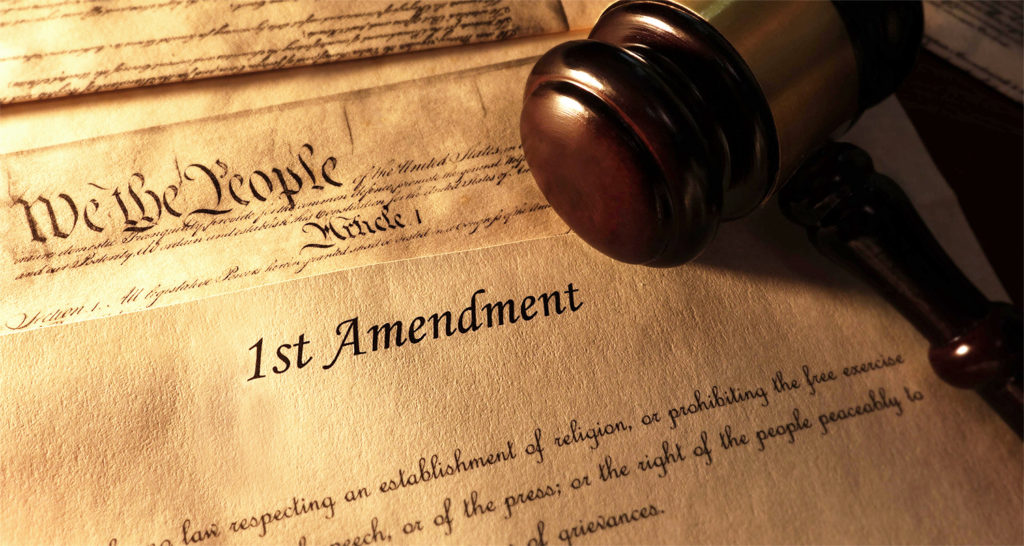
The First Amendment has fully shaped how this nation can communicate their feelings while actively using their freedoms to the fullest extent. What many people sets the United States apart from other nations is its sense of freedom. Freedom to speak on what you believe in, what religion you would like to practice, assembly, and petition. The First Amendment reads, "Congress shall make no law respecting an establishment of religion, or prohibiting the free exercise thereof; or abridging the freedom of speech, or of the press; or the right of the people peaceably to assemble, and to petition the Government for a redress of grievances."
https://study.com/academy/lesson/effect-of-democratic-practices-on-free-speech.html
One favorable characteristic of our nation is the fact that citizens have the right to call out the government on actions that may appear to be unconstitutional. The ideas of democracy and free speech are closely intertwined. With free speech, it increases citizens interest in politics because they feel protected by our First Amendment Rights to speak freely. Voting for example: due to the fact that all citizens have the right to vote on who they feel would best serve as President of our nation, people are forced to do research on the climate of our nation and make a decision which exercises our First Amendment rights.
While the First Amendment may seem very cut and dry, during my time in Talking About Freedom with Dean Smith, I have learned the complexity of how these laws protect us. During the Civil Rights Era, many events that took place, were only possible because of the First Amendment. A popular idea that arose during the Civil Rights Era was the idea of nonviolent resistance. Nonviolent resistance was the theory of achieving goals for a change by using practices such as civil disobedience, symbolic protests, and more.
https://www.history.com/topics/black-history/montgomery-bus-boycott
One event that occurred during this era used the idea of nonviolent resistance would be the Montgomery Bus Boycott. Rosa Parks refused to give her seat up for a white man, was arrested and fined, and within days the entire town of Montgomery, Alabama was ready to boycott the bus system. The boycott went on for 381 days as many residents decided they would not stop until the demands of integration were met. While this case was settled to be a violation of the 14th Amendment, integration would not have happened if it weren't for actions that were protected by the First Amendment. This is an event that harnesses the right to petition the government by allowing bus riders to actively not partake in the activity they felt needed to be changed.
Another favorable characteristic of our nation, it promotes citizens getting involved and using their rights to make an everlasting change. Due to the Montgomery Bus Boycott, a Montgomery federal court ruled any law that required racially segregated seating on buses was a clear and present violation of the 14th Amendment. By showing there can a positive outcome from actions taken that are protected by the First Amendment, it encourages others to exercise the rights that protect them as well.
https://kinginstitute.stanford.edu/encyclopedia/nonviolence
While we discussed an event that advanced the cause of civil rights, a person who had a great role to play in this era was Dr. Martin Luther King Jr. Notorious for his influential speech "I Have a Dream," MLK Jr. spoke frequently of his practices using nonviolence. King stated he was "fascinated by the idea of refusing to cooperate with an evil system". King referred to nonviolence as a theory that can be applied to many situations and can serve us as a "guiding light".
https://www.history.com/topics/black-history/march-on-washington
MLK Jr. played an important role in the March on Washington which was another event that used the concept of nonviolence to positively impact the Civil Rights Era. The March on Washington was a massive protest march in which MLK Jr. gave his "I Have a Dream Speech," while the event was created in an effort to draw attention to the inequalities faced by African Americans. The March on Washington was met by approval of JFK Jr. who was serving his term of president at the time. JFK Jr. was in full support of the march as long as it did not end in violence.
Many safety precautions were taken for the March. JFK Jr. had his brother and attorney general, Robert F. Kennedy, coordinate with many organizers to ensure all safety precautions were taken. In addition, the original plan for the march was to have the end point be the Capitol however, the final destination was changed to the Lincoln Memorial in an effort to prevent members of Congress feel as if they were under attack. At the end of the march, MLK Jr. gave his famous "I Have a Dream" speech which would later turn into a landmark event in the Civil Rights Era.
These events are events in which the actions of the people partaking in them were protected by the 1st Amendment. If there were no laws in place protecting our freedoms during the Civil Rights Era, the era would have been short lived. Although many important laws were not yet passed for this era, the 1st Amendment had enough protection for the U.S. citizen to protest and encourage change.


No comments:
Post a Comment